
Unmasking Tooth Decay: Causes, Symptoms, and Treatment Options
Unmasking Tooth Decay: Causes, Symptoms, and Treatment Options
Tooth decay is one of the most common oral health concerns for patients across Richmond Hill, Oak Ridges, Aurora, and King City. It develops gradually, often starting long before you notice sensitivity, pain, or visible changes in your teeth.
Every time you eat, bacteria naturally present in plaque feed on sugars and starches left behind, producing acid as a byproduct. When plaque sits on teeth for too long, these acids continuously attack the hard outer surface of the tooth, leading to demineralization where enamel loses essential minerals.
Key Takeaway: Tooth decay isn't a sudden emergency—it is a gradual process driven by bacteria, acid, and time. Catching enamel breakdown early allows our Richmond Hill team to restore your smile with conservative, comfortable treatments before deeper damage occurs.
What Causes Tooth Decay to Develop?
Plaque is a sticky film of bacteria that forms on teeth daily. When plaque is not removed effectively through routine brushing and cleaning between teeth, acids remain in contact with enamel for extended periods.
Sugary Foods & Frequent Snacking
Sipping sweet drinks or grazing throughout the day gives bacteria a constant fuel supply to produce enamel-weakening acid.
Inconsistent Daily Hygiene
Skipping brushing or cleaning between teeth allows plaque to accumulate along the gumline and between tight teeth.
Dry Mouth Concerns
Saliva washes away food debris and neutralizes acid. Reduced saliva flow leaves enamel far more vulnerable to acid attacks.
Deep Grooves & Missed Cleanings
Deep molar fissures trap food, while skipping professional cleanings allows plaque to harden into tartar that brushing can't remove.
Cavities Explained Simply
Think of tooth decay as the process and a cavity as the result. When enamel repeatedly loses minerals without recovery, the surface collapses and creates a permanent opening in the tooth—a cavity.
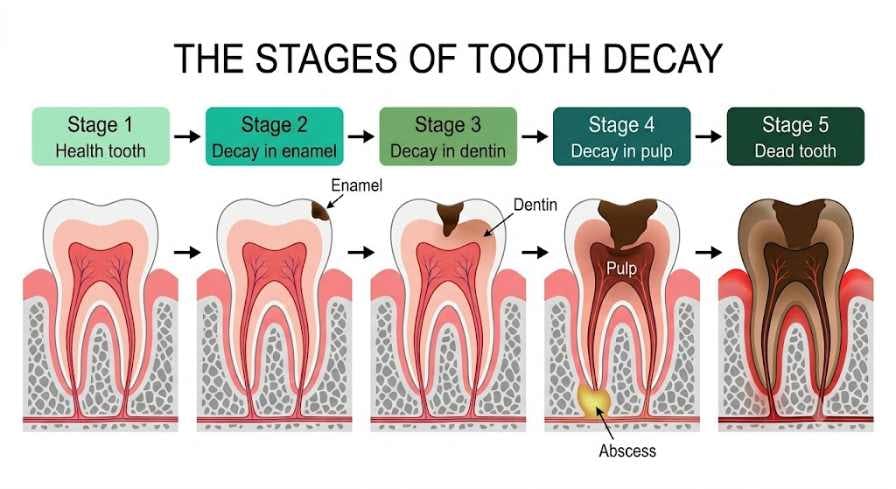
A cavity develops in clear, progressive phases:
- Enamel Demineralization: Early mineral loss appearing as chalky white spots.
- Enamel Cavity: Physical hole breaks through the outer protective shell.
- Dentin Breakdown: Decay reaches the softer layer beneath, spreading faster and increasing sensitivity.
- Inner Pulp Damage: Decay hits nerves and blood vessels, leading to persistent discomfort.
As decay passes through enamel into dentin, it spreads faster. Left untreated, decay can reach the inner pulp where sensitive nerves reside.
Early Tooth Decay Symptoms to Watch For
Early decay often develops quietly without pain. That is why routine family dental exams in Richmond Hill are so important—we can often spot early demineralization during a visit before you feel any discomfort.
Early warning signs include: Sensitivity to cold, heat, or sweets; chalky white or rough patches; visible brown spots; and food catching in one spot. Advanced symptoms include: Sharp pain, throbbing toothaches, visible holes, and swelling.
How Tooth Decay Progresses Over Time
Stage 1
Early Demineralization: Minerals leave enamel. Fluoride care can still help halt or reverse damage.
Stage 2
Enamel Breakdown: A hole physically forms. A standard tooth-coloured filling is needed.
Stage 3
Dentin Involvement: Decay spreads faster in softer tissue. A larger filling or crown is required.
Stage 4
Pulp Involvement: Infection reaches the nerve. Root canal therapy is needed to save the tooth.
Treatment Options for Tooth Decay
Our restorative dental approach at Bamboo Dental focuses on removing damaged structure, halting decay, and reinforcing your tooth so it functions naturally.
Common restorative options include:
- Fluoride & Preventive Support: Ideal for very early, pre-cavity weak spots to support mineral recovery.
- Tooth-Coloured Fillings: Used for small to moderate cavities to rebuild lost structure seamlessly.
- Dental Crowns: Recommended when extensive structure has been lost and the tooth requires overall reinforcement.
- Root Canal Therapy: Necessary if decay reaches the inner pulp, removing infected tissue to save the physical tooth structure.
- Tooth Replacement Options: If a tooth cannot be saved due to severe breakdown, custom dental implants or bridges restore complete function.
What Home Care Can—and Cannot—Do
Daily hygiene is your foundation for oral health, but it has natural limits.
What Home Care CAN Do: Brushing twice daily with fluoride toothpaste and flossing removes soft plaque and reduces acid buildup to prevent new cavities.
What Home Care CANNOT Do: It cannot repair a physical cavity once a hole forms, nor can it safely scrape away hardened tartar deposits.
Combining consistent home habits with professional care at Bamboo Dental ensures complete, long-term protection for every smile in your family.
Keep Your Family's Smiles Healthy & Bright
Located at 6-141 King Rd in Richmond Hill (Oak Ridges), the team at Bamboo Dental is dedicated to providing gentle, modern dental care in a relaxed environment. Whether it's time for a routine cleaning, a checkup for your kids, or addressing tooth sensitivity, we are here to help.
Ready to protect your smile? Book your appointment online at Bamboo Dental or call our friendly team at (905) 505-2061 today.
Book Online
Bamboo Dental offers the ability to request your dentist appointments online. Schedule an appointment now!
Book Online